


Blog - How Far Is It Right? (The Analysis)
- ruchira nigam
- Dec 24, 2025
- 3 min read

Updated: Dec 25, 2025
Blog No. 3425/PI - (Part 2) - Written by -
Ms. Anuradha Gupta, Founder General Secretary, Prithvi Innovations
( if you support the Aravalli Bachao Citizens Movement
then do "JOIN US " to Save Aravalis)
Hindi Blog Link - https://drive.google.com/file/d/1bVfiWNITqHOHAv_3-HnrNIhCOafPrgr0/view?usp=sharing
We invite your views and perspective and once again request you to show your solaridarity to the Aaravalis , our oldest ecological natural heritage with unlimited potential to avert water crisis, Air pollution, biodiversity loss, desertification, only and only if left undisturbed by human beings, the mining mafias and real estate owners, in the name of development and tourism.
Its high time we all raise our collective voice and forget all our differences and become one strong force to persuade the Government and the Supreme Court to reconsider their biased decision and stop all the Greenwash around Aravalli .
Please sign this petition and support all groups in Rajasthan, Haryana, NCR who are fighting for Aravallis.
Summary
The government's actions effectively shrink the legal footprint of the Aravalis to only the tallest hills, leaving the foothills and flat forests vulnerable. While the government claims this brings legal clarity and has promised strict monitoring, the general Indian public - especially environmentalists and urban residents - perceives this as a regressive step that threatens the region's water security and air quality.
here is a breakdown of the specific critical areas and impacts that are currently at the center of the debate:

1. The "Mangar Bani" Controversy
The Context: Mangar Bani (off the Gurugram-Faridabad highway) is a sacred grove protected by villagers for centuries. It is arguably the last remaining virgin forest in the NCR.
The Risk: Under the new definitions (height/density criteria), the buffer zones around Mangar Bani are vulnerable. If these buffers are developed into real estate, the sacred grove will become an isolated "island," cutting off wildlife paths for leopards and hyenas, eventually killing the ecosystem.
2. The Water Crisis Specifics
The Science: The Aravalis contain natural cracks and fissures that act as a funnel, guiding rainwater underground.
The Impact:
Gurugram & Faridabad: These cities are already extracting groundwater faster than it replenishes. The water table is dropping by 1 to 2 meters every year.
Consequence: If the foothills are paved over (due to the new 100m rule), this natural recharging stops. Experts predict Gurugram could hit "Day Zero" (running out of groundwater) much faster than anticipated.
3. The "Dust Bowl" Effect
The Barrier: The Aravalis act as a shield against the sand blowing in from the Thar Desert in the west.
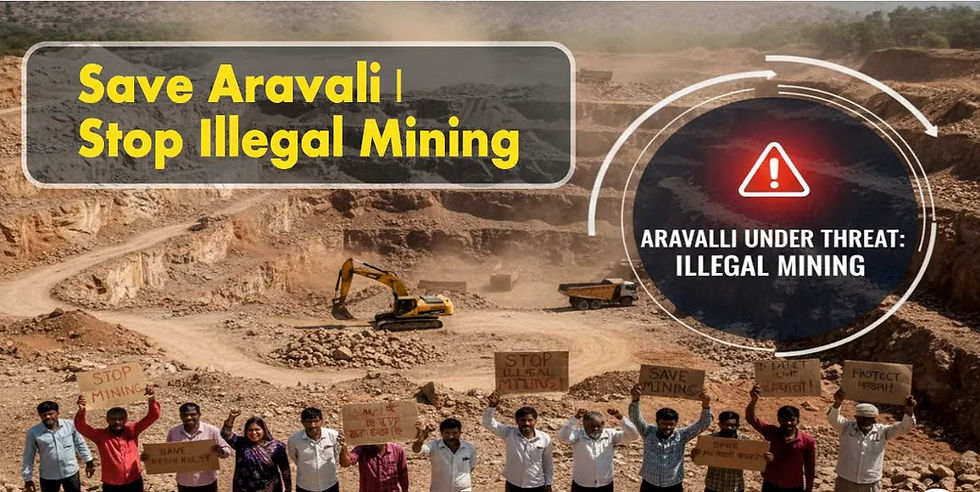
The Breach: Several gaps have already appeared in the range due to illegal mining (notably in the gaps between Jaipur and Delhi).
Consequence: Without the hills to block the wind, sand drift is expanding toward Delhi and Western UP, increasing the suspension of Particulate Matter (PM10) and making the air quality index (AQI) permanently worse, not just in winter.
4. Wildlife Conflict
The Animals: The region is home to leopards, hyenas, jackals, and nilgai.
The Conflict: As the "deemed forest" protection is removed, construction moves closer to wildlife ‘ sightings in urban areas of Gurugram and South Delhi as animals are forced out of their shrinking territories
.
How Far Is It Right? (The Analysis)
The debate is polarized between "Development/Standardization" and "Ecological Survival."
Arguments For Government Actions | Arguments Against (Ecological & Ethical Concerns) |
Clarity & Uniformity: The 100m definition solves the confusion caused by different states (Haryana, Rajasthan) having different rules for what counts as a "hill." | Ecological Fragmentation: Nature does not follow a "100-meter" rule. Low-lying hills and scrublands are critical wildlife corridors. Removing their protection fragments the ecosystem. |
Combating Illegal Mining: The government argues that a clear definition allows for better policing of illegal mining in protected zones. | "Death Warrant" for Water: The Aravalis are the primary groundwater recharge zone for Delhi-NCR. Paving over low-lying areas for real estate will worsen the region's severe water crisis. |
Sustainable Development: The government claims "sustainable mining" is necessary for the economy and construction materials, provided it is regulated. | Air Pollution Risk: The Aravalis block dust from the Thar Desert. If the range is thinned out (by mining low hills), dust storms in Delhi-NCR will increase, worsening the already toxic air quality. |
Afforestation: The "Green Wall" project shows the government is committed to increasing tree cover, even if legal definitions change. | Greenwashing: Critics argue that planting saplings (Green Wall) cannot replace the destruction of mature, million-year-old ecosystems and geological formations. |
Verdict: From an ecological standpoint, the actions are viewed as highly risky. While legal clarity is good, the specific criteria chosen (100m height) effectively de-notifies vast ecologically sensitive areas, prioritizing real estate and mining potential over environmental security.


Comments